The Jelling Stones and the Birth of Scandinavia
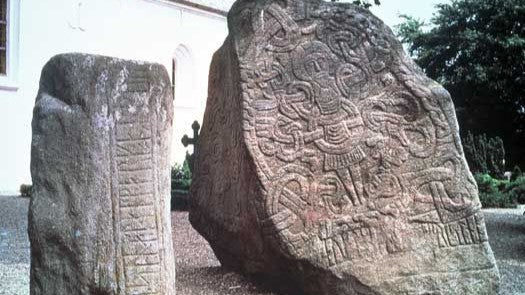
In the heart of Jutland, Denmark, stand two massive rune stones that represent the very soul of the Viking Age. Known as the Jelling Stones, these monuments are often called the "Certificate of Baptism" for the Danish nation. They mark a pivotal moment in history when the disparate tribes of the North began to coalesce into a unified kingdom, and the old gods of the Aesir began to share the landscape with the arrival of the "White Christ." For any traveler or enthusiast of Norse heritage, these stones are the ultimate evidence of how the Vikings transformed from raiding parties into the founders of modern Europe.
The Small Stone: Gorm’s Tribute to Thyra
The story begins with the smaller of the two stones, raised by King Gorm the Old around the year 950 AD. Gorm was the last purely pagan king of a unified Denmark, and his stone is a deeply personal monument. The inscription reads: "King Gorm made this monument in memory of Thyra, his wife, Denmark's adornment." This is a significant moment in historical linguistics, as it is the first time the name "Denmark" appears on a stone within the country's own borders. It reveals a culture that, while often viewed as rugged and warlike, placed immense value on the legacy of women and the concept of a shared national identity.
The Great Stone: Harald’s Bold Declaration
Beside Gorm’s monument stands a much larger, three-sided stone raised by his son, Harald Bluetooth. This stone is a masterpiece of Viking art and a bold political manifesto. On one side, Harald honors his parents; on the second, he claims to have "won for himself all of Denmark and Norway"; and on the third, he declares that he "made the Danes Christian." The artwork on the Great Stone is world-famous, featuring a massive, intricate carving of a "Great Beast" locked in battle with a serpent, a classic motif of the Mammen art style. This stone was originally painted in vibrant reds, blues, and yellows, standing out against the green mounds like a beacon of royal power.
A New Faith in the Old Style
Perhaps the most iconic image on Harald’s stone is the depiction of Christ. Unlike the suffering figures often seen in Southern European art of the time, the Jelling Christ is a Viking Christ. He stands upright, entwined in Celtic-style knotwork, looking more like a triumphant warrior or a cosmic pillar than a victim. This shows the unique way the Norse people adapted the new religion without entirely abandoning their aesthetic roots. The Jelling site, with its two massive burial mounds and its church, became a symbolic bridge. It allowed the Norse elite to maintain their traditional "mound-building" prestige while entering the political and religious mainstream of medieval Europe.
The Legacy of the Jelling Style
Today, the "Jelling Style" of art, characterized by s-shaped, ribbon-like animals and interlacing patterns, continues to influence modern design and jewelry. The stones themselves are UNESCO World Heritage sites, protected by glass cases to prevent the soft granite from weathering away, yet their message remains clear. They tell the story of a people who were masters of change. The Jelling Stones remind us that the Viking spirit was not just about the axe and the sail, but about the ability to build a kingdom, to honor one's lineage, and to navigate the shifting tides of history with confidence and artistry.