Viking Burials: The Oseberg and Gokstad Ships
For a Viking, the end of life was not a departure from the world but a final voyage toward a new one. The grandest of these departures involved the burial of entire ships, transforming massive oak vessels into eternal chambers for the dead. Among the most breathtaking archaeological finds in Europe are the Oseberg and Gokstad ships, discovered in Norway. These vessels provide an intimate look at the wealth, artistry, and spiritual depth of the Norse people, proving that for the elite of the Viking Age, the transition to the afterlife required the finest craftsmanship human hands could produce.
The Oseberg Ship and the Queen of the North
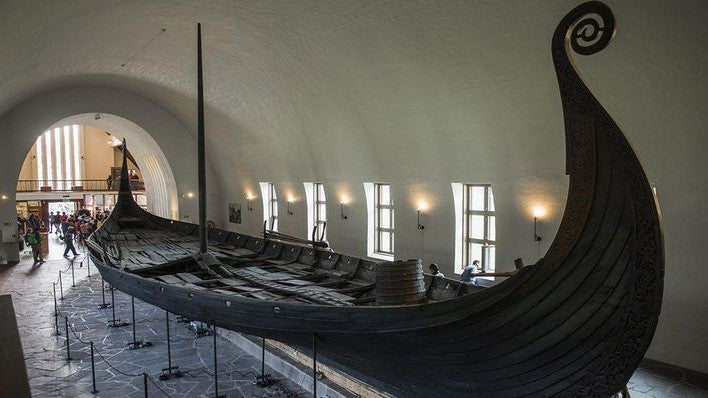
Discovered in 1903 beneath a massive burial mound, the Oseberg ship is widely considered the most beautiful Viking artifact ever found. Built around 820 AD, this longship served as the final resting place for two powerful women, one of whom is believed by many historians to have been a queen or a high priestess. The ship itself is a masterpiece of the "Oseberg Style," characterized by intricate, swirling carvings of "gripping beasts" that climb the prow and stern. The burial was packed with a stunning array of grave goods meant to serve the women in the next world, including four elaborately carved sledges, a working wagon, and even the remains of fifteen horses. This burial reveals that women held positions of immense status and religious authority in Norse society, commanding a funeral of unparalleled grandeur.
The Gokstad Ship: The Vessel of a Great Chieftain
While the Oseberg ship is celebrated for its beauty, the Gokstad ship, discovered in 1880, is a testament to the engineering brilliance of the Viking Age. Built around 890 AD, this was a true seaworthy warship, fast and flexible enough to cross the open Atlantic. It served as the tomb for a powerful man in his fifties, a warrior of great physical stature whose bones showed the scars of many battles. Unlike the delicate carvings of the Oseberg, the Gokstad ship focused on functionality and strength. When it was unearthed, thirty-two shields were still fastened to each side of the ship, painted in alternating yellow and black. This ship proved to modern historians that the descriptions of "shield-rimmed vessels" in the sagas were not mere poetic flourishes but a literal reality of the Viking navy.
Spiritual Voyages and Material Wealth
The inclusion of a ship in a burial mound was a profound statement of faith. The Norse believed the ship would carry the deceased across the sea to the halls of the gods, whether that be Odin’s Valhalla or Freya’s Sessrúmnir. The mounds were not merely graves; they were portals. Inside these ships, archaeologists found everything a household might need, from kitchen utensils and fine textiles to iron tools and decorative jewelry. These items were not just "gifts" for the dead but essential equipment for the eternal journey. The sheer effort required to drag a full-sized ship inland, fill it with treasures, and cover it with tons of earth shows that the community viewed the honor of their leaders as a shared sacred duty.
The Legacy of the Ship Burials
Today, the Oseberg and Gokstad ships are preserved in Oslo, standing as silent witnesses to a culture that valued both the sword and the chisel. The intricate woodcarvings and the sleek lines of the hulls continue to inspire modern Norse art and jewelry. When we look at the dragon-headed prows of these ships, we see the heart of the Viking spirit: a refusal to go quietly into the dark and a desire to meet the unknown with everything one has built and earned. For the modern descendant or enthusiast, these ships are a reminder that our own "voyages" are defined by the beauty we create and the legacy we leave behind in the hearts of those who remain.