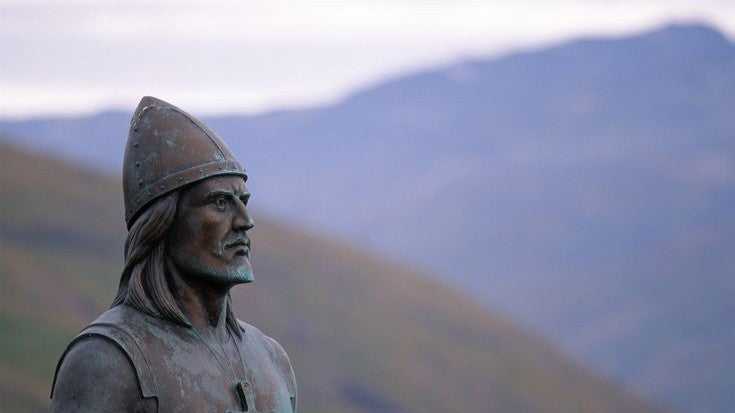
Beyond Columbus: Leif Erikson and the Norse Settlement at Vinland
Nearly five centuries before Christopher Columbus set sail across the Atlantic, a crew of thirty-five Norse mariners steered a single-masted wooden merchant vessel into the cold waters of North America. Led by Leif Erikson (Leifr Eiríksson), these northern seafarers established the first European foothold in the Americas. Known in Old Norse tradition as Vinland (Wineland), this distant territory represented the ultimate frontier of Scandinavian expansion. The story of its discovery is not a grand tale of imperial conquest, but a masterclass in Atlantic navigation, resourcefulness, and boundary-pushing exploration.
The Voyage of Leif the Lucky
According to the 13th-century Icelandic texts The Saga of the Greenlanders (Grænlendinga saga) and Eirik the Red’s Saga (Eiríks saga rauða), the Norse path to America was blazed through a mix of navigational skill and accidental discovery. Around the year 986, a trader named Bjarni Herjólfsson was blown off course during a voyage from Iceland to Greenland, sighting heavily forested, unfamiliar land to the west. Though Bjarni did not land, his reports ignited the curiosity of young Leif Erikson.
Son of Erik the Red, the founder of the Norse Greenland colonies, Leif purchased Bjarni’s ship, assembled a skilled crew, and set out around 1000 AD to find these mysterious western shores.
Steering by latitude, ocean swells, bird flights, and celestial positions, Leif traced Bjarni’s route in reverse:
-
Helluland (Land of Flat Stones): Likely modern Baffin Island, described as a bleak, barren landscape of massive glaciers and slab-like rock.
-
Markland (Forest Land): Modern Labrador, a heavily wooded coastline rich in timber, a resource desperately needed in treeless Greenland.
-
Vinland (Wine Land or Meadow Land): A lush, temperate region further south where wild grapes grew in abundance, rivers teemed with salmon, and winter frosts were mild enough for cattle to graze outdoors.
Building Leifsbúðir: The Settlement at L’Anse aux Meadows
Upon reaching Vinland, Leif and his crew built temporary wooden longhouses and timber shelters to pass the winter, naming the encampment Leifsbúðir (Leif’s Booths).
For decades, historians debated whether the sagas were mere heroic legends. That changed in 1960, when Norwegian explorer Helge Ingstad and archaeologist Anne Stine Ingstad discovered the remains of an 11th-century Norse settlement at L'Anse aux Meadows on the northernmost tip of Newfoundland, Canada.
Archaeological excavations uncovered undeniable evidence of Norse habitation:
-
Eight Turf-Walled Buildings: Constructed in the exact style of contemporary 11th-century Scandinavian longhouses found in Greenland and Iceland.
-
A Smeltery and Forge: Containing iron slag, charcoal, and hand-forged iron rivets used specifically for ship repair.
-
Domestic Artifacts: Including a bronze ringed pin of West Norse design, a soapstone spindle whorl used for spinning wool, and carved wooden timber pieces bearing Norse carpentry marks.
The presence of butternut wood and wild walnuts at the site confirmed that the inhabitants ventured further south into the Gulf of St. Lawrence, harvesting luxury resources to send back to Greenland.
Conflict, Distance, and the Retreat from Vinland
Despite the abundant timber, wild grapes, and rich salmon streams, the Norse presence at Vinland was short-lived. Unlike later European colonization efforts, the Greenland colony lacked the population density and military backing required to sustain a permanent colony thousands of miles across open water.
The primary hurdle was conflict with the indigenous populations, whom the Norse called Skrælingar (likely early Innu or Dorset peoples). Initial trade interactions involving red cloth and milk quickly turned into hostile skirmishes. Coupled with internal feuds among the settlers and an immensely long supply line across treacherous North Atlantic waters, the Norse realized that maintaining a permanent settlement was unsustainable.
After a few years of occupancy and subsequent seasonal timber-harvesting expeditions, the site at L’Anse aux Meadows was abandoned, allowed to sink back into the Newfoundland sod.
The Real Legacy of the Vinland Expeditions
Leif Erikson earned the nickname "Leif the Lucky" (Leifr hinn heppni) for his successful voyage, financial rewards, and safe return to Greenland, where he assumed leadership of the colony following his father's death.
The story of Vinland proves that Viking Age mariners were far more than seasonal coastal raiders. They were master navigators whose courage, shipbuilding technology, and oceanic knowledge allowed them to bridge two continents centuries before the rest of Europe. Today, the ancient turf outlines at L’Anse aux Meadows stand as a monument to human curiosity and the absolute outer limit of the Norse world.