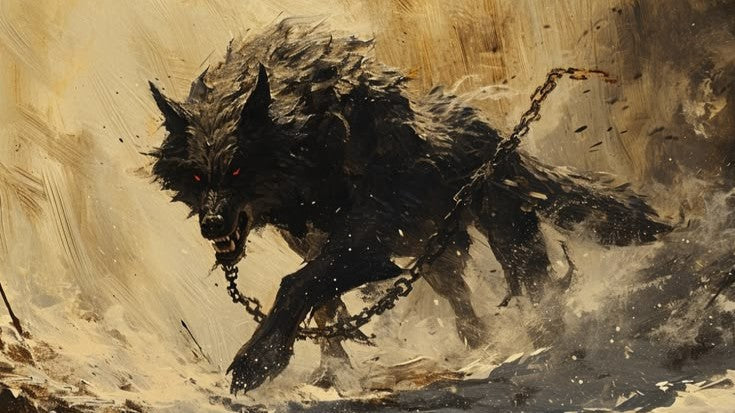
Fenrir and the Binding of Fate: The Cosmic Wolf of Northern Legend
In the vast spectrum of Old Norse mythology, few creatures evoke as much awe, tragic complexity, and existential terror as Fenrir (also known as Fenrisúlfr). Born to the trickster god Loki and the giantess Angrboða, this massive wolf was not merely a monster to be slain; he was a cosmic force of destruction whose very existence was inextricably woven into the end of the world. The tale of Fenrir’s growth, his inevitable binding by the gods, and his tragic role at Ragnarok offers a profound look into how the ancient North viewed fate, betrayal, and necessary sacrifice.
The Prophecy and the Beast in Asgard
When the Aesir gods discovered Loki’s three monstrous children; Hel, the Midgard Serpent Jörmungandr, and the wolf Fenrir, they recognized the terrible prophecies associated with them. While Jörmungandr was cast into the deep ocean and Hel was sent to rule the realm of the dead, the gods chose to bring the pup Fenrir to Asgard so they could keep a watchful eye on him.
Only one god possessed the courage to approach and feed the growing pup: Tyr, the god of law, honor, and martial justice.
As time passed, Fenrir grew at an alarming rate. His immense size, bone-crushing jaws, and supernatural intelligence struck fear into the hearts of the gods. Realizing that the wolf would soon become unstoppable, the Aesir knew they had to bind him to prevent the fulfillment of his dark destiny.
The Tests of Strength: Leyding and Dromi
Out of fear, the gods attempted to trick Fenrir under the guise of testing his strength in sport. They brought forward heavy iron fetters and challenged the wolf to shatter them:
-
Leyding: A heavy iron chain. Fenrir allowed himself to be bound, stretched his powerful limbs, and effortlessly snapped the iron links.
-
Dromi: A chain twice as strong, forged from massive iron rings. Fenrir allowed the gods to bind him again, but with a mighty kick, shattered Dromi into fine splinters.
Realizing that no physical iron forged by gods or men could hold the beast, Odin sent a messenger to Svartalfheim, the underground realm of the Dwarves, to request a magical restraint.
Gleipnir: Forged from Impossible Things
The master dwarven smiths crafted a ribbon named Gleipnir. Though it appeared as thin, smooth, and delicate as a silk ribbon, it was imbued with unbreakable ancient magic. To forge it, the dwarves combined six impossible ingredients:
-
The sound of a cat’s footfall
-
The beard of a woman
-
The roots of a mountain
-
The sinews of a bear
-
The breath of a fish
-
The spittle of a bird
When the gods brought Fenrir to the isolated island of Lyngvi and presented the silk-like ribbon, the wolf grew suspicious. Sensing a trap, Fenrir agreed to be bound with Gleipnir under one strict condition: one of the gods must place their right hand inside his jaws as a pledge of good faith.
The Sacrifice of Tyr and the Binding
The gods stood in silent dread, knowing that accepting the condition meant permanent maiming. Only Tyr stepped forward. With unwavering courage, he placed his right hand inside Fenrir's terrifying mouth.
The gods wrapped Gleipnir tightly around the wolf. As Fenrir kicked and struggled to break free, the magical ribbon grew tighter and stronger, binding him completely. Realizing he had been betrayed, Fenrir clamped his jaws shut, severing Tyr's hand at the wrist. The gods cheered at their triumph, save for Tyr, who had sacrificed his hand to preserve the peace of the Nine Realms.
The gods secured the magical tether to a massive stone slab named Gjöll and wedged a sword into Fenrir’s open jaws to keep him from biting, leaving him bound in darkness.
| Fetters Used | Material | Outcome |
| Leyding | Standard Iron | Shattered effortlessly by Fenrir |
| Dromi | Heavy Duty Forged Iron | Snapped apart into splinters |
| Gleipnir | Magical Dwarven Ribbon | Successfully bound the wolf |
Ragnarok: The Breaking of the Chains
The tragedy of Fenrir lies in the self-fulfilling nature of Norse fate (örlög). By betraying the wolf and binding him in torment, the gods ensured the very vengeance they sought to prevent.
When the apocalyptic signs of Ragnarok arrive, the earth will tremble, mountains will crumble, and Gleipnir will finally snap. A raging Fenrir will burst free, his lower jaw touching the earth and his upper jaw scraping the sky, fire blazing from his eyes and nostrils.
In the final battle on the plains of Vigrid, Fenrir will swallow Odin whole, fulfilling the ancient prophecy before being slain by Odin's son, Vidar.
Lessons in Fate and Compromised Honor
The story of Fenrir remains one of the most powerful narratives in Northern lore. It illustrates a core truth of the Norse worldview: that destiny cannot be avoided, and attempting to escape fate through deceit often creates the very disaster one fears. Above all, it honors the archetype of Tyr; showing that true justice and leadership often require personal sacrifice for the greater good.